

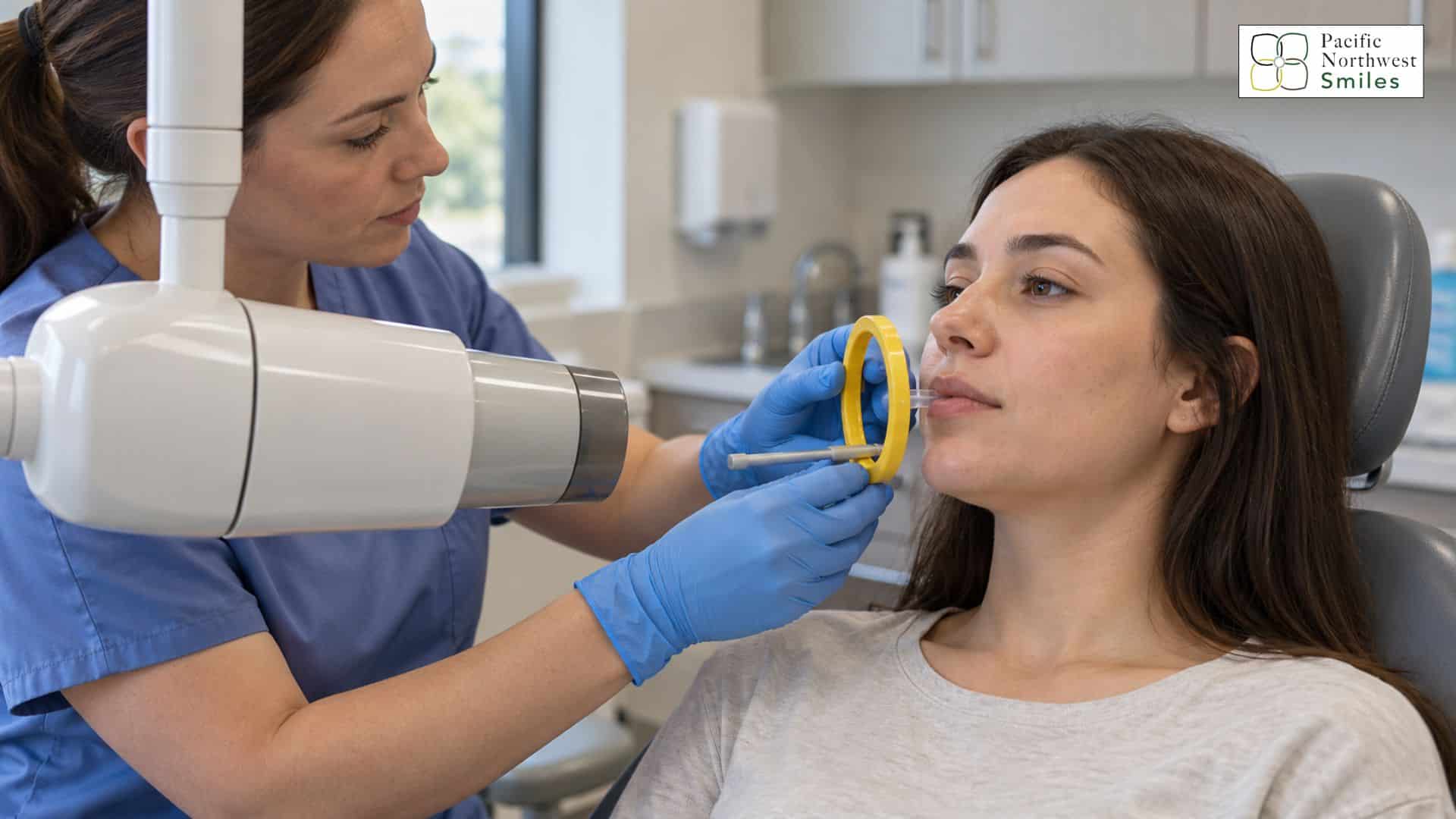
No. You do not automatically need dental X-rays at every checkup. Your dentist determines whether imaging is needed based on your oral health, symptoms, risk of dental disease, previous images, and examination findings.
The American Dental Association and American Academy of Oral and Maxillofacial Radiology updated their patient-selection recommendations in 2026, emphasizing that imaging should support an individual patient’s diagnostic or treatment needs.
Your checkup schedule and X-ray schedule may therefore be different.
- Dental X-rays are selected according to clinical need.
- Usable images from your previous dentist may help avoid unnecessary repeats.
- Different types of imaging answer different questions.
- Ask what the recommended image will show and how it could affect your care.
How Does Your Dentist Decide When You Need Dental X-Rays?
Your dentist reviews your history and examines your mouth before deciding whether imaging will provide useful information. The time since your last X-rays matters, but it is only one part of the decision.
Your Oral Health and Risk Factors Guide the Recommendation
Factors that may influence imaging include:
- Signs or symptoms of dental disease
- Risk of tooth decay or gum disease
- Age and stage of dental development
- Previous dental treatment
- Findings during the examination
- The information available in previous images
Children and teenagers may have different imaging needs because their teeth and jaws are developing.
An examination can identify reasons to investigate an area even when you have no pain. Pacific Northwest Smiles provides general dentistry in Mill Creek, including examinations and oral-health records that help track changes over time.
Previous Images May Still Be Useful
If you have changed dentists, tell the new office when and where your most recent X-rays were taken. Ask whether those images can be transferred before your appointment.
Your dentist will consider whether they:
- Show the area being evaluated
- Are clear enough for diagnosis
- Reflect your current condition
- Answer the question raised by the examination
Being a new patient does not automatically mean every image needs to be repeated. Additional imaging may be necessary if the available records do not provide enough information.
Discussing What an Image Could Change With Dr. Greenhalgh
Dr. Darren Greenhalgh practices general and cosmetic dentistry at Pacific Northwest Smiles. His background includes earning his Doctor of Dental Surgery degree from Case Western Reserve University and teaching other dentists about CEREC restorations.
When discussing an X-ray recommendation, ask which finding needs a closer look and how the image could affect your care. For example: “Are you checking for decay between teeth, evaluating a root, or looking at bone support?” A specific question can make the explanation easier to follow.
Why Might You Need X-Rays When Nothing Hurts?
Some dental conditions develop before they cause noticeable symptoms. X-rays can reveal information about areas that cannot be fully assessed by looking inside your mouth.
This is one reason regular dental examinations remain important even when your teeth feel comfortable. Whether imaging is needed still depends on your individual findings and risk.
Images Can Reveal Hidden Changes
Depending on the image selected, dental X-rays may help evaluate:
- Decay between teeth
- Bone changes around teeth
- Impacted or developing teeth
- Certain infections and root-related problems
- Injuries to teeth and supporting structures
- Previous dental treatment
Your dentist interprets these images alongside the examination and your history. An X-ray alone does not provide the complete picture of your oral health.
Different Images Answer Different Questions
A small image taken inside your mouth may show one tooth or a group of teeth. A panoramic image provides a broader view of the teeth and jaws.
The appropriate choice depends on what needs to be assessed. You can ask:
- Which area will this image show?
- What are you trying to evaluate?
- Could my previous images answer that question?
- How might the result change my treatment?
Ask your dentist to point out the relevant area and explain the finding in everyday language.
CBCT Is Used for Specific Clinical Needs
Cone-beam computed tomography, or CBCT, uses X-rays to create three-dimensional images. It can help with selected situations, such as implant planning, certain root canal assessments, impacted teeth, or dental trauma.
CBCT generally involves more radiation than conventional dental X-rays, although exposure varies with the equipment, settings, and area scanned. It should be selected when lower-exposure imaging cannot adequately provide the information needed.
If CBCT is recommended, ask what additional detail it will provide and how that information will guide care.
A three-dimensional optical scan differs from CBCT. Optical scanners record visible surfaces without using X-rays, so ask which type of scan is being discussed.
How Is Unnecessary Radiation Exposure Reduced?
Dental X-rays use ionizing radiation. The aim is to obtain information that benefits your care while avoiding unnecessary exposure.
Pacific Northwest Smiles lists digital X-rays among its preventive dentistry services. The need for a particular image should still be determined individually.
Protection Begins With Selecting Necessary Images
Radiation protection includes choosing the appropriate examination, using suitable exposure settings, and limiting the area being imaged.
Correct positioning helps obtain a useful image and reduces the chance of a repeat exposure. Children require particular care because they are more sensitive to radiation than adults.
Digital equipment can help reduce exposure, but each imaging examination still needs a clinical reason.
Lead Apron Recommendations Have Changed
The ADA’s 2024 radiation-safety recommendations no longer advise routine lead apron or thyroid collar use during dental imaging. Shielding can sometimes enter the image area and lead to repeat imaging.
Current recommendations emphasize careful image selection, beam restriction, positioning, and appropriate exposure settings. Dental practices must also follow applicable radiation-safety requirements.
Ask the team to explain its approach if you notice a change from previous visits.
Tell the Team About Pregnancy
Tell your dental team if you are pregnant or think you may be pregnant.
Clinically necessary dental X-rays can be performed during pregnancy. Your dentist can explain why an image is needed and consider your circumstances when planning care. Do not assume an urgent dental problem should wait until after delivery.
Ask for an Explanation You Can Use
Before proceeding, ask:
- Why is this image needed now?
- What information is missing from the examination?
- Could existing images be used?
- What are the benefits and risks of taking or delaying it?
- How could the result affect my care?
If the explanation is unclear, ask the dentist to connect the image to the concern being investigated.
A Separate Perspective on Dental Practice Communication
Patients may also be interested in how dental practices approach communication and the patient experience. The Dental Marketing Secrets Podcast discusses these subjects from a practice-management and marketing perspective.
It is intended primarily for dental professionals and practice owners. It is not a clinical reference for X-ray frequency or radiation safety; questions about your imaging needs should be discussed with your treating dentist.
Frequently Asked Questions
Do I Need Dental X-Rays Every Six Months?
No. A six-month checkup does not automatically require X-rays every six months. Imaging frequency depends on your risk, symptoms, previous images, and examination findings.
Can My New Dentist Use Images From My Previous Office?
Possibly. Ask your former office to transfer them. Your new dentist will assess whether they are suitable for your current needs. If you are also resuming dental care after several years, share an approximate date of your last visit and any records you can obtain.
Are Dental X-Rays Risk-Free?
No imaging that uses ionizing radiation is entirely risk-free. Your dentist should recommend an examination when its expected clinical benefit outweighs the radiation risk and use techniques that limit exposure.
Does Every Patient Need a CBCT Scan?
No. CBCT is used for specific diagnostic or treatment-planning questions when lower-exposure imaging cannot provide enough information. It is not an automatic part of every checkup.
Should I Skip My Checkup If I Do Not Need X-Rays?
No. An examination remains useful even when imaging is unnecessary. Your dentist can assess your teeth, gums, oral tissues, and symptoms and recommend an appropriate follow-up schedule.
Have questions about dental imaging at your next visit? Contact Pacific Northwest Smiles in Mill Creek, WA, and let the team know about previous X-rays or concerns you would like to discuss.